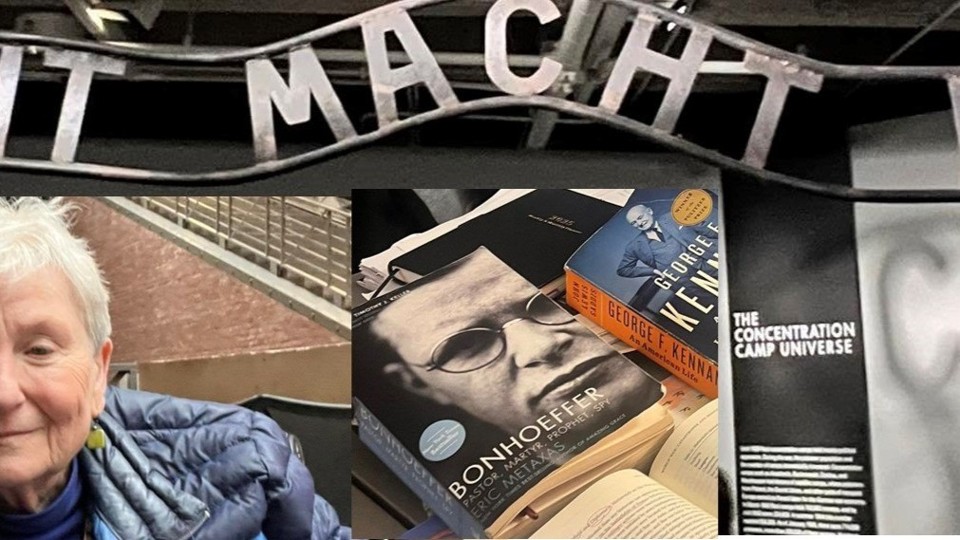
Written March 6, 2025
One of the many books I’m reading simultaneously each month is the biography of Dietrich Bonhoeffer (the Movie doesn’t do justice to his real life) along with the 757 page biography of Klemens von Metternich during Napoleon’s time. As I learn about how Bonhoeffer in early 1930s was able to see through the farce of the German political party that came to power in 1933, I wanted to learn more about how everything happened in German society in the Early years of 1930s; how the power structures were dismantled, how democracy was undermined, how propaganda was used, how blinded everyone was, way before WWII actually started. I wanted to also learn how the concentration camps of 1933-1934 were set up, why, and how German society degraded into state sponsored killing periods of the 1940s.
I quickly went over to the Holocaust Museum in Washington DC – since I have time while laid off during these times of 2025. The biography of Bonhoeffer is a powerful testament to how one struggles to navigate taking a stand against evil, figuring out how to resist, either from outside or inside of the system, the ethical, moral, and righteous battles waged inside oneself to do what’s right. Metternich also, during the early 1800s from Austria was able to see the evil of Napoleon’s wars across Europe and the farce of what Napoleon was doing – the drive for power. Metternich spent years seeing beyond the farce, and created coalitions and allies to stop Napoleon. It took years of going against even his own system and Empire, to get the other European powers to realize the threat of Napoleon, and that Napoleon could be defeated if all allies formed a coalition. Only in the last coalition after nearly 15 years of war, could Metternich and the allies beat Napoleon.
Going back to Bonhoeffer’s time in the early 1930s it is all eye opening, to see how easily a breakdown of society can occur – though it doesn’t seem like it, until it’s too late. Reference Martin Niemöller’s (contemporary of Bonhoeffer) famous poem “First they Came” – posted below – of not speaking out until it was too late. From even before Hitler came to power, Bonhoeffer could see through the farce, the lies, and ultimately the evil – even though Hitler proclaimed ‘religion, Christianity, the church’ to the masses. Bonhoeffer was able to uniquely discern right from wrong, always stood up for what was right – this virtue lost on pretty much all society we’re the individual is focused on self (I speak of Germany in 1930s, and American in 2020s – people are only focused on saving themselves or achieving power for themselves). He spent ten years from when the Nazi’s came to power, attempting to tell the German church not to align with the Nazi’s or Hitler. Bonhoeffer himself wouldn’t bow, even when his fellow church and state people were all marching in line behind Hitler, and excusing his rhetoric (“to save Germany, God has risen Hitler up to save Germany, etc…”) that Bonhoeffer was just an alarmist, etc.
Bonhoeffer (and we) struggle with ethical and moral dilemmas such as: if the laws and state say to put Jews on a train, and you’re just carrying out the law, or, put an immigrant in a detention center because it’s the law, but if you resist, your career is done, where is the line to stand up, or stay complicit, and be a law abiding citizen or help to be in a position to stand up later? Usually it’s too late by the time one says enough is enough. And in the case of Germany, millions end up being murdered, all by those “carrying out orders, just following the law.” These million deaths didn’t start off immediately, my trip to the Holocaust Museum helped me/us see that early in 1933, the Nazi’s started (small) with detaining political opponents, immigrants, deformed children, mixed race persons, Jews, Poles and more. Ten years later of course was the systematic killings we know about when we think of the Holocaust. But not only did this happen in Europe during WWI, but also in Romania during Nicolae Ceausescu’s period, during Stalin’s era, Mao Zedong ended up killing tens of millions. Even now in Congo and Rwanda, Myanmar, and Russia doing it in Ukraine today… unspeakable atrocities, and no one speaking up. At the Museum, and from Bonhoeffer’s biography, I learned and saw that these sorts of atrocities occurred early on, starting with small changes in administration (to the cabinet, legislature, parliament), changing laws, declaring national emergencies, eliminating press, having no checks and balances, getting rid of opposition, unchecked power to security forces, speaking lies in all public statements as you rally crowds, and creating an enemy (people) that those in charge can denigrate, and using propaganda and symbols to unite people to a person not a constitution or state.
I am NOT saying that we are in Nazi times, or Germany. We are America in 2025. This writing is not to draw parallels. I am just showing what happened in Germany, and to be mindful of how quickly silence and acquiesce can lead to consequential horrors beyond imagination. The people of Germany around the concentration camps had no idea what was happening inside the camps. The power of propaganda in Nazi society coupled with a complete controlling of media plus keeping journalists out of detention centers is immense.
Reading Bonhoeffer helps us understand how even when he was in Berlin among all centers of power, one’s conviction of truth from error can still be used to stand up and do what’s right though lots of prayer and speaking out and writing and staying true even to the point of being sentenced to death, and executed. He wouldn’t stop preaching or writing even though the state forbad him hundreds of times to stop writing and teaching and it cost him his life.
First they came for the Communists, And I did not speak out Because I was not a Communist. Then they came for the Socialists, And I did not speak out Because I was not a Socialist. Then they came for the trade unionists, And I did not speak out Because I was not a trade unionist. Then they came for the Jews, And I did not speak out Because I was not a Jew. Then they came for me, And there was no one left To speak out for me.
—German pastor Martin Niemöller (1892–1984)
Holocaust Museum photo captions – Feb 2026 Referencing 1930’s Germany
FOUNDATIONS OF A DICTATORSHIP Hitler assumed power under a guise of lawfulness that concealed his true intentions. Conservative politicians underestimated him; left-wing politicians were equally nave. Neither took Hitler seriously until it was too late first, the new government included only three Nazis: Miller as Chancellor, and Hermann Göring and Wilhelm Frick in ministerial posts. Once in power they quickly laid the legal foundations for a Nazi dictatorship. On February 27, 1933, a fire destroyed parts of the German parliament building. the Reichstag. Hitler immediately accused the Communists, an opposition party. of setting the blaze, and he issued an emergency decree that allowed him to crush political opposition. This decree became the basis of the Nazi police state, and would remain in effect until 1945. On March 23, a Nazi-dominated parliament voted to transfer all legislative powers to Miller’s cabinet. After this Enabling Act, the parliament would serve merely as a rubber stamp. Finally, all political organizations except the Nazi party were banned, on July 14. The one party state was thus established within six months of Hitler’s appointment to Chancellor.
TOOLS OF PERSUASION Nazi propaganda drew its power from the government’s absolute control over the flow of information. All news media were censored by Joseph Goebbels’s Propaganda Ministry. Freedom of speech was ruthlessly suppressed. Beginning on September 1, 1939, Germans who listened to uncensored information on foreign radio broadcasts risked severe punishment. Endless rallies, parades, speeches, rituals, and sham elections were tools of public persuasion. Every year, Germans were expected to participate in hundreds of Nazi events. Such ceremonies reinforced Nazi ideology among the faithful and helped to weed out the disobedient. Goebbels also exploited the latest techniques of film and radio to communicate Nazi achievements. The government made inexpensive radios (“people’s receivers*) available to every German household
In Nazi Germany, power was centralized in one person, Adolf Hitler. The Hitler dictatorship demanded the public’s unconditional obedience, and it tolerated no criticism or dissent. Organizations refusing to conform with Nazi ideology were destroyed. Most German organizations were quickly placed under Nazi control. Belonging to them was advisable if not compulsory. Farmers were forcibly united in the nationwide association of “Reich Food Producers”; labor unions were replaced by the “German Labor Front.” In 1934, acting in accordance with the Nazi “Leader Principle,* soldiers in the German army swore allegiance not to the constitution or the state, but to Hitler personally. Even the Christian churches fell under Nazi influence, and many Protestant and Roman Catholic officials openly supported the regime. Only the dissident Protestant Confessing Church declared that unquestioning obedience to the state was not compatible with Christian faith. From childhood, every stage of a German’s life was dominated by the Nazi state. The Hitter Youth and the League of German Girls prepared young people for lifelong service to the party. Tours of duty in the Reich Labor Service and the army were obligatory for men. Women were expected to bear “pure Aryan” children as a service to Nazi society, and mothers were given awards according to the number of children they bore.
A USELESS CONFERENCE From July 6 to 15, 1938, delegations from 32 nations met at Evian-les-Bains, France, to identify refugee havens for German and Austrian Jews. Country after country acknowledged the refugees’ plight, yet offered little more than excuses. Great Britain would admit few Jews, and kept Palestine closed to large-scale Jewish immigration. Canada was willing to accept farmers, but this did not help the urban Jews of Austria and Germany. Australia declined to assist because it “does not have a racial problem, and [is) not desirous of importing one.” The Venezuelan delegate was reluctant to disturb the “demographic equilibrium” of his country: no Jewish merchants, peddlers, or intellectuals were wanted there. The Netherlands and Denmark offered only temporary asylum. The United States finally agreed to admit—for the first time—the full legal quota for immigrants from Germany and Austria. The Dominican Republic alone offered to receive a substantial number, 100,000 Jews.
Under SS control, Theresienstadt served multiple functions: as an assembly center before transporting Jews to other ghettos, camps, or killing centers; as a ghetto for elderly and “prominent” Jews from Germany and Austria; as a labor camp; and, in 1944, as a propaganda vehicle to deceive the world about the Nazis systematic mass murder of Europe’s Jews. Approximately 155,000 Jews from the Czech lands, Germany, Austria, the Netherlands, Denmark, Hungary, and Slovakia were deported to Theresienstadt. Of these, 83,000 died in Nazi killing centers, other ghettos, or in labor camps. Another 35,000 perished in Theresienstadt itself from malnutrition, disease, and the harsh conditions. Some 15,000 children passed through Theresienstadt; almost all of them perished. In spite of the terrible living conditions and the constant threat of deportation, Theresienstadt had a highly developed cultural life. Artworks by Jewish artists included clandestine depictions of the ghetto’s harsh reality.
 Strategic Perception Analytics LLC
Leave a comment